
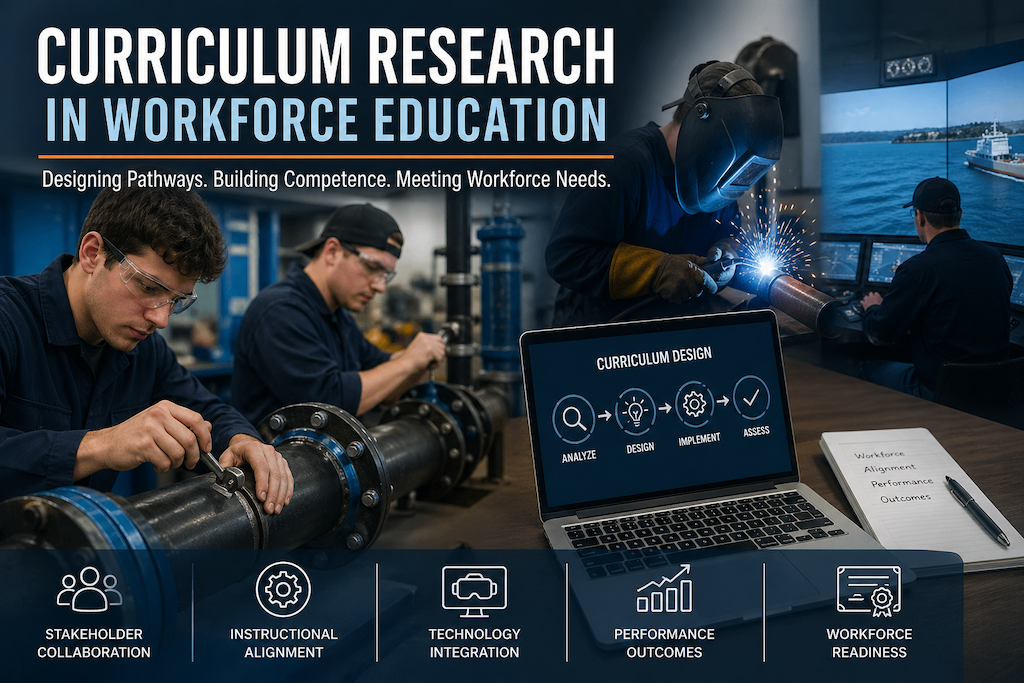
As part of my ongoing doctoral research in curriculum design and instructional development, I have been examining how curriculum functions within workforce education environments. While the course itself is grounded in theory and research methodology, my applied focus is centered on real-world implementation—specifically within programs at the Community College of Rhode Island (CCRI), where I teach and conduct instructional work.
One of the clearest findings so far is the disconnect between traditional curriculum structures and the realities of workforce performance. Academic sequencing often assumes a linear progression of knowledge acquisition; however, in practice, workforce roles—such as those in pipefitting and maritime training—require integrated, task-based competence. Learners must synthesize knowledge, procedural skills, and decision-making in real time. This aligns with research on immersive and applied learning environments, which emphasizes that learning is most effective when it mirrors authentic task conditions (Radianti et al., 2020; Jensen & Konradsen, 2018).
A second emerging insight involves the balance between structure and flexibility. Coherent curriculum pathways are necessary for ensuring progression, but overly rigid structures can limit learner success—particularly when students enter with varying levels of prior experience. In workforce education, this variability is the norm, not the exception. Effective curriculum design must therefore maintain standards while allowing adaptive entry points and progression pathways.
Alignment has also surfaced as a critical variable. When learning objectives, instructional strategies, and assessments are tightly aligned—particularly around measurable performance outcomes—students demonstrate stronger skill transfer. Conversely, misalignment results in superficial learning that does not translate into operational competence. This reinforces the importance of structured instructional design approaches that integrate pedagogy, technology, and assessment in a cohesive manner (Hughes & Roblyer, 2023).
Technology integration is another area where findings are becoming more defined. Tools such as simulations, digital twins, and interactive instructional media have strong potential to bridge the gap between classroom and field. However, their effectiveness is entirely dependent on how well they are embedded within the instructional strategy. Technology that is not instructionally aligned introduces complexity without improving outcomes, a point consistently emphasized in technology integration research (Hughes & Roblyer, 2023).
Finally, stakeholder integration is emerging as a non-negotiable component of curriculum development. Curriculum designed without input from instructors, industry partners, and learners risks becoming disconnected from workforce expectations. In applied environments like CCRI, aligning curriculum with actual job performance requirements is essential for ensuring graduate readiness and program credibility.
These findings collectively point toward a broader conclusion: workforce curriculum must evolve beyond static, content-driven models and move toward dynamic, performance-centered systems. The objective is not simply knowledge acquisition, but the development of demonstrable, job-ready competence.
As this research progresses, the next phase will focus on refining implementation strategies and evaluating how these principles can be systematically applied across programs to improve both learning outcomes and workforce readiness.
References (APA 7th Edition)
Hughes, J. E., & Roblyer, M. D. (2023). Integrating educational technology into teaching: Transforming learning across disciplines (9th ed.). Pearson.
Jensen, L., & Konradsen, F. (2018). A review of the use of virtual reality head-mounted displays in education and training. Education and Information Technologies, 23(4), 1515–1529. https://doi.org/10.1007/s10639-017-9676-0
Radianti, J., Majchrzak, T. A., Fromm, J., & Wohlgenannt, I. (2020). A systematic review of immersive virtual reality applications for higher education: Design elements, lessons learned, and research agenda. Computers & Education, 147, 103778. https://doi.org/10.1016/j.compedu.2019.103778